
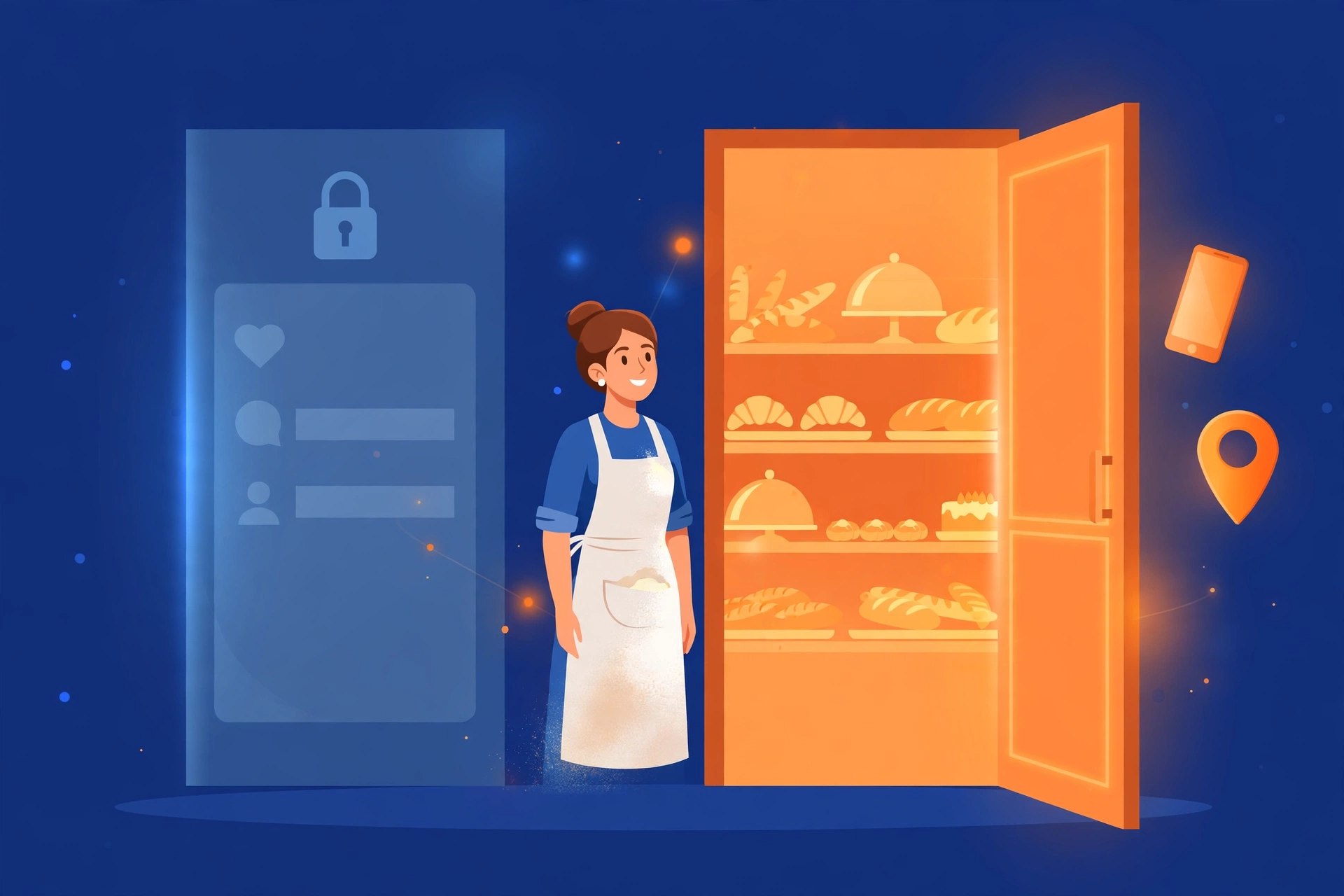
简短回答: A Facebook page vs website comparison usually starts with price — the Page is free — but that is the wrong place to start. A Facebook Page is a good noticeboard: it shows your hours, your photos, and a way to message you, and for a brand-new business it is better than nothing. What it cannot do is be found by everyone, in the way they actually search. People who are not on Facebook cannot see much of it, Google gives your own website far more room than a Page, you cannot control its layout, its booking flow, or what appears beside your name — and the Page is rented land: an account problem or an algorithm change can make it vanish or go quiet overnight. Most established small businesses end up with both: the Page for regulars, a website as the front door everyone can walk through.
What a Facebook Page genuinely does well
Credit where it is due. A Page costs nothing to set up, takes an afternoon, and is a reasonable first presence for a business that opened last month. Regulars can follow it, message it, and see a Saturday special the day you post it. Reviews collect there, events are easy to announce, and Meta’s own Facebook Pages for business overview walks through the setup and the basic tools without any technical skill. If the choice is genuinely “a Page or nothing at all,” choose the Page.
The problems start when “better than nothing” quietly becomes the whole online strategy — because the limits below do not show up in month one. They show up in year two, when a competitor with a real website starts collecting the searches you never see.
Limit 1: A large share of your customers cannot really see it
Facebook shows a limited preview to people who are not logged in, and a substantial share of adults simply do not use the platform at all. A customer who finds your Page from a Google search may hit a login wall before they find your phone number. Compare that with how people actually look for a local business: they search Google, often with the word “near me,” and they judge what they can read in full, immediately, without signing up for anything. Your Google 商家资料 is free too, and it feeds those searches — but like a Facebook Page, it is a listing, not a home: it shows the facts and points onward, ideally to a website you control. A Page plus a Google listing is a sensible start. Neither one is a destination with your story, your full offer, and a form that lands in your inbox.
Limit 2: Google gives websites the room — and the questions
When someone searches for what you do, Google’s results page has space for your website’s own words: the page that explains the service, the page that answers the price question, the page that covers your neighbourhood. A Facebook Page gets, at best, a single line in those results, and what it says is whatever the platform decides to show. That matters more every year, because customers increasingly ask questions — of Google, and now of AI assistants — and get answers assembled from websites that actually contain the answers. Our guide to small business homepage mistakes makes the same point from the other side: the first screen someone lands on has about five seconds to explain what you do and how to reach you. On your own site, you write that screen. On a Page, the platform writes it, in the same template as every competitor.
Limit 3: You do not control the layout, the flow, or the neighbours
On a Page, your most important information competes with everything the platform puts around it — including, at times, ads and suggestions for other businesses. You cannot decide that the phone button comes first, that the booking form has three fields instead of twelve, or that your best work appears before your oldest post. Those decisions sound cosmetic until you price them: our guide on how to write a contact page exists because the difference between a form people finish and a form people abandon is worth real enquiries every month. A website lets you make those decisions. A Page lets you post into a feed and hope the layout is kind that week.
Limit 4: Rented land can change the locks
Businesses lose Pages — to hacks, to disputed admin access when the employee who created the Page leaves, to automated flags nobody can appeal quickly, and to simple reach declines when the platform re-tunes what followers see. None of this is a reason to delete a Page; it is a reason not to keep your only copy of your customer-facing presence somewhere you cannot restore it from. A website on your own domain is the opposite arrangement: you own the address, the content, and the backups, and if you ever change builders or hosts, the site moves with you. The honest framing of facebook page vs website is not “free versus paid.” It is “borrowed versus owned” — and borrowed is fine as a channel, risky as a foundation.
Facebook page vs website: the side-by-side, honestly
A Page wins on: starting cost (free), speed of setup, messaging regulars, and casual reach among people who already follow you. A website wins on: being found by everyone through search, answering questions in your own words, controlling the path from first visit to enquiry, collecting enquiries somewhere you own, and still existing, unchanged, when a platform changes its rules. Notice the pattern: the Page is better at talking to people who already know you; the website is better at being found by people who do not — and growth lives in the second group. That is also why the two work best together: the website carries the searchable substance, and the Page (and your other social posts) points back to it. Our small business website checklist shows how little a proper first site actually has to contain — a handful of pages, done in the right order.
Frequently asked questions
Is a Facebook Page enough for a new business?
For the first weeks, it can be a reasonable placeholder while the business finds its feet — together with a free Google Business Profile so searchers can find your hours and number. Treat it as scaffolding, not the building: every month it remains your only presence is a month of searches going to competitors whose websites answer them.
Can customers without Facebook see my Page?
Only partially. Logged-out visitors typically get a limited view and frequent login prompts, and they cannot message you or use Page features. A website has no such gate: anyone with the address sees the whole thing, which is why your domain belongs on your van, your invoices, and your shop window — it works for every customer, not just the ones on one platform.
Will a website show up on Google better than my Page?
In practice, yes — because a website gives Google pages of your own words to match against searches, including the specific services and areas you work in, while a Page offers a single platform-written summary. The facebook page vs website gap is widest exactly where it counts: the customer who has never heard of you and is searching for what you do.
Do I still need the Page if I get a website?
Keep it. The Page stays useful for regulars, quick updates, and messaging, and it costs nothing to maintain lightly. Just reverse the dependency: let the website be the complete, searchable home, and let the Page point people to it — a link in the About section and in posts — instead of the Page being the only place your business exists online.
How much does a simple business website cost?
Far less than the “free” Page can cost in missed searches. Our 价格页 lists complete small-business sites from US$299 plus HST — one payment for an asset you own outright, built phone-first and search-ready. Compare that with even one job a month going to the competitor a customer found first.
Keep the Page. Own the front door.
If your Facebook Page is currently your whole online presence, do not delete it — demote it. Let it keep doing what it does well for your regulars, and give your business the front door everyone else is looking for: your own website, at your own address, saying what you do in your own words. Start with our services overview if you want to see what a first site includes, or 免费获取报价 and tell us your Page address — we will show you exactly which searches it is missing, and what a site that catches them would look like.